
Joel Kotkin | Neo-Feudalism: Tech Oligarchs and the Secular “Clerisy” (Transcript)
Class Unity
- posted on
- No Comment
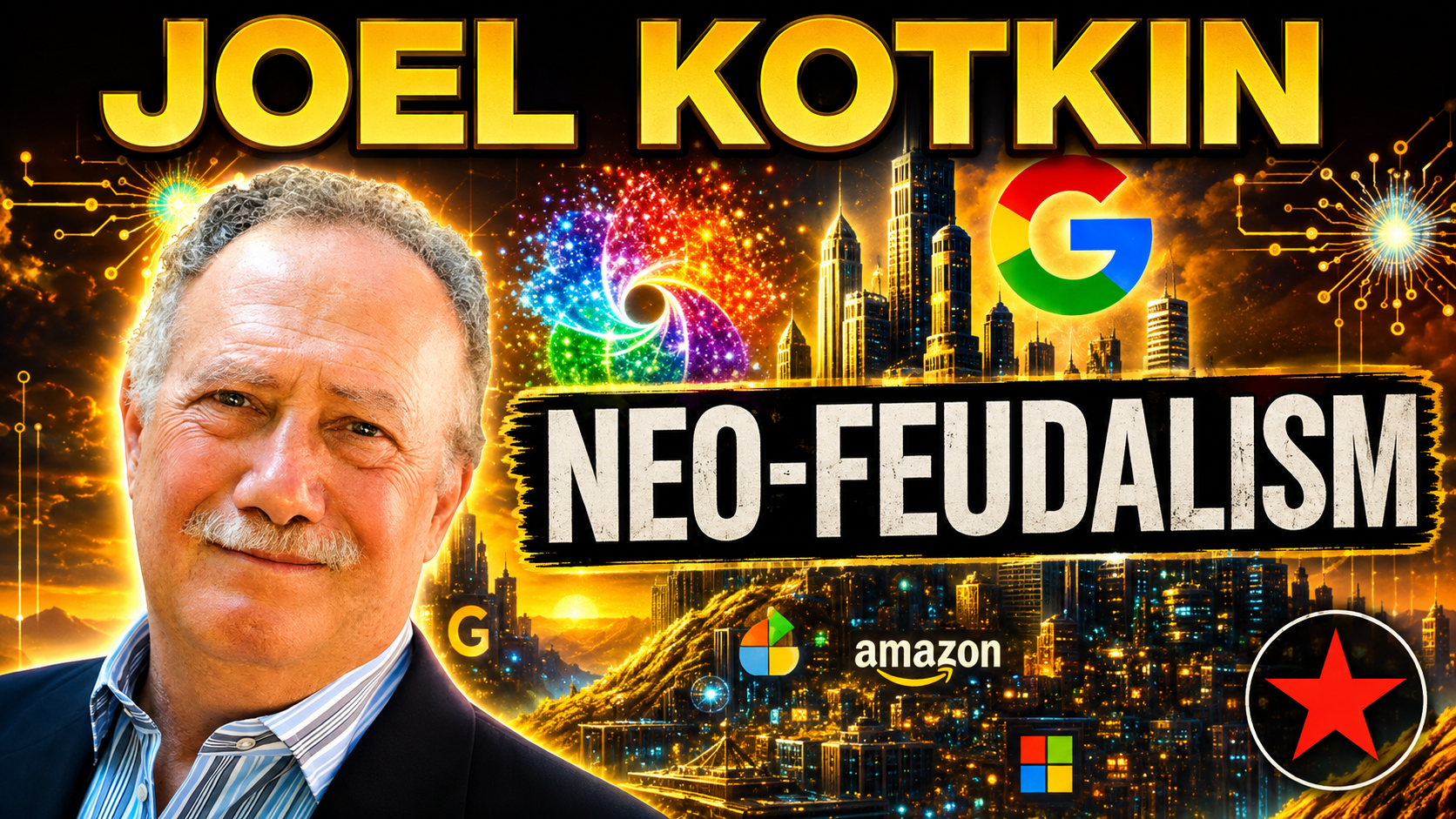
Joel Kotkin | Neo-Feudalism: Tech Oligarchs and the Secular “Clerisy”
Class Unity recently spoke with urban theorist Joel Kotkin about his concept of neo-feudalism and the growing concentration of economic, technological, and cultural power. Drawing on The Coming of Neo-Feudalism: A Warning to the Global Middle Class, Kotkin describes an emerging order dominated by tech oligarchs and a secular “clerisy,” while property ownership and upward mobility recede for working- and middle-class people. The conversation examines oligarchic socialism, artificial intelligence, environmental policy, deindustrialization, housing costs, financialization, and the decline of competition. It also considers whether economic populists across the conventional left-right divide could form a majoritarian alliance around antitrust, industrial policy, local autonomy, and wider ownership. Readers can watch the original Class Unity video, visit the related Class Unity event page, and find Kotkin’s book and other work on his official website.
Class Unity: Hello, everyone, and welcome to another Class Unity event. Today we are speaking with Joel Kotkin about neo-feudalism. Joel Kotkin is a writer on urban affairs and a fellow in urban studies at Chapman University in Orange, California. He is a regular contributor to The Daily Beast and The Spectator, as well as the author of several books. In 2020, he published The Coming of Neo-Feudalism: A Warning to the Global Middle Class, which will be the focus of our discussion. Joel, thank you very much for speaking with us.
Joel Kotkin: My pleasure.
Class Unity: To begin, could you offer some general remarks on neo-feudalism? What do you mean by the term, and what are its consequences today?
Joel Kotkin: Neo-feudalism does not mean that we are literally repeating the feudal system. Mark Zuckerberg is not running around in chain mail. What we have instead is an unprecedented rise of a relatively small class. My background is in classical history, so I tend to look at matters this way: at the end of the Roman Empire, a vacuum emerged, and the strongest people became the aristocracy. Something comparable happened during the digital revolution.
There was a period of perhaps ten or fifteen years when it was unclear who would benefit from this epochal change, which artificial intelligence is now accelerating. Much of the established corporate world reacted very slowly. New firms were therefore able to seize territory and build oligopolies with 80 or 90 percent market share in critical fields. This process has continued regardless of whether a conservative or liberal government is in office. It has become a force of nature that will be extremely difficult to address because these companies wield power not only over the transmission of information, but also over its content. That combination is frightening.
Because I have spent a great deal of time in Japan, I sometimes call the process “zaibatsuization.” The Japanese zaibatsu resembled German cartels but were more extensively developed: a bank sat at the center of a group of companies operating across many industries. When Amazon, Google, and Apple all try to enter health care, one has to ask where this stops. We could end up with ten companies controlling 80 percent of the economy’s vital assets. I am not sure that is positive.
Class Unity: We will return to the article you published in spiked today, but first we would like to ask some broader questions. The class language in the subtitle of your book is striking: it is “a warning to the global middle class.” What is the global middle class, who or what is threatening it, and what is the warning? What should the middle class do, and why do you use the analogy to feudalism?
Joel Kotkin: The class that brought feudalism to an end—or at least fundamentally redefined it—was what I call the middle class, the old Third Estate in France. Historically, it consisted of artisans and mechanics, but also small-business owners and people who owned modest amounts of property. This group has long been the bulwark of democracy. Greek and Roman democracy were not what we would call democracy today, but across many countries one can see the middle class gradually challenging aristocratic authority.
The Netherlands is an interesting example. By reclaiming land from the North Sea, it expanded the land base and broadened homeownership. The underlying ideal was that people should possess a certain degree of self-sufficiency. We saw a remarkable realization of that ideal from the end of the New Deal through the postwar period, not only in the United States but also in the United Kingdom, Japan, Australia, and Sweden. Governments wanted people to own homes, build assets, and receive decent wages. I am old enough to remember that world. My father served in the army and used a GI Bill loan to buy a house on Long Island when we moved out of Brooklyn.
The middle class expanded dramatically. From roughly 1950 through the 1960s, the very wealthy did not fare especially well relative to everyone else, while broad sections of the population made real gains. Minority populations also entered the middle class in growing numbers, despite the discrimination they faced. There was tremendous upward movement.
That movement began to slow in the 1970s and 1980s, particularly in the West, as globalization eliminated jobs and trade unions weakened. Property and control over the commanding heights became concentrated in an ever smallergroup. That is an unfortunate development. I wish I had a complete answer to what should be done, but there must at least be greater dialogue between populists of the right and populists of the left. Being a populist does not make someone a fire-breathing Marxist or Maoist; it can simply mean recognizing that the present situation is not good.
I teach a course on artificial intelligence and its implications for the future with a friend who works as a data analyst. When I ask young people whether they expect to buy a home, almost none of them believe they will. They certainly do not expect to buy in Orange County, where a household may need an income of $250,000 or $300,000 to afford a median-priced home. The opportunity horizon for the next generation is shrinking. I tell my conservative friends that if people neither own property nor have any prospect of owning it, why should they not vote for Bernie Sanders? What does the existing system offer them?
If the path to ownership and advancement disappears, the likely alternative is something I call oligarchic socialism. California offers an example. State policies have harmed the working class through high electricity costs, the loss of businesses that once provided good livelihoods, and extraordinarily expensive housing. At the same time, the welfare state has expanded and more people depend on government transfers. This remains financially possible because California contains several of the world’s largest corporations and people with enormous capital gains who can finance the state budget.
The distinction between right-wing and left-wing technology executives is incidental. Their common interest is preserving their oligopolies, wealth, and power. Eventually, they may strike a bargain with the larger population: you receive three thousand dollars a month, but you should not expect to own a home, start a substantial business, or compete with us. Oligarchic wealth keeps people above absolute poverty and forestalls mass revolt.
It resembles the Roman policy of bread and circuses. People may live in small, partially subsidized apartments and spend their time on pornography, video games, or other forms of entertainment. I work extensively around technology, and I think this content will become increasingly difficult to resist. The metaverse did not arrive in the form Zuckerberg expected, but the longer-term movement toward artificial and immersive content continues. Instead of controlling a character in a game, a person will enter the experience and become, for example, the greatest gladiator in first-century Rome.
That world will be extraordinarily enticing. If a society loses the value of work and the emphasis on building things, it may become a population managed through immersive entertainment and drugs. The book that best predicted this future is Brave New World. Its controllers could conceivably create a society in which most people are relatively satisfied. It would not be free, and it would not offer upward mobility, but it might be stable.
Class Unity: Could you clarify what you mean by oligarchic socialism?
Joel Kotkin: Oligarchic socialism socializes some wealth—including some of the wealth held by oligarchs—to compensate for the disappearance of work. People receive a dole because they no longer possess the means to support themselves independently. In the fictional scenario I constructed, it is 2032. President Gavin Newsom worries about a challenge from Senator AOC and makes a deal with the oligarchs: the existing situation is impoverishing people, so the state will provide basic sustenance to the population while the oligarchs continue to dominate.
Class Unity: In that sense, it is ultimately a subsidy for the ruling class: welfare payments flow back to companies such as Netflix and Amazon.
Joel Kotkin: That is a very good point. The problem, identified in an interesting French paper, is that eventually customers do not have enough money to buy anything. Whatever its defects, traditional capitalism depended on a population with purchasing power. Henry Ford was a horrible human being, but he produced affordable cars and paid high wages for the period because he understood that he needed customers who could buy his product. We are in danger of destroying that kind of consumer base. In the long run, that may rebound against the oligarchs, but it will hurt everyone else first.
Class Unity: Another class—or perhaps subclass—that appears in your writing is the “clerisy.” It seems to be either part of the middle class or a class of its own, whose interests align it with the ruling class against the traditional middle class. Could you explain it?
Joel Kotkin: The term comes from Samuel Taylor Coleridge, who wrote about it in the nineteenth century. The clerisy replaces what France called the First Estate and becomes the source of moral authority. Religious figures still form part of it, but the modern clerisy consists primarily of academics, the media, the nonprofit world, and other people who continually tell society what it ought to do, much as clerics once did.
Much of the clerisy is financed by oligarchs, so the causes it pursues rarely threaten oligarchic wealth and power. It also has its own agenda, and the two classes sometimes conflict. Medieval Europe had Thomas Becket and many other struggles between the religious establishment and the aristocracy. Yet the clerisy and oligarchy are generally closely aligned, and the clerisy is a rising class.
It also provides substantial urban support for candidates described as socialist. Many members of the clerisy do not earn enough to live comfortably in San Francisco or New York, so the cost-of-living issue has considerable appeal to them.
Class Unity: We have several questions about environmental policy and environmental sustainability from different perspectives. How are environmental policies used by technology oligarchs in ways that harm the working class? And for people genuinely concerned about climate change and other environmental problems, what should be done?
Joel Kotkin: One lesson of following these issues for half a century is that nothing stays the same, even when certain patterns endure. Technology oligarchs historically presented themselves as environmentally benign because their companies appeared to use relatively little energy. Artificial intelligence has changed that: it requires enormous quantities of power.
As matters stand, renewable energy alone cannot produce that power at an affordable price. The places with the most restrictive energy policies tend to have the highest prices. There may be ways around the problem, but the solution will eventually have to include nuclear power. I do not see how we get there without it.
Oligarchs supported restrictive environmental policies as a form of virtue signaling, but higher electricity costs fall very differently across classes. For upper- and even upper-middle-class households, an electricity bill is at worst a nuisance. California’s coastal areas have an exceptionally mild climate. Travel twenty miles inland and summer temperatures may be ten or twenty degrees hotter, while winters can also be colder. Those inland areas contain a much larger share of the working class, which therefore bears more of the energy burden.
California’s climate agenda also penalizes development in places where people need cars, although roughly 97 percent of Californians commute by automobile. Working- and middle-class people who want to buy homes must move farther away and drive. Riverside County is one of the fastest-growing large counties in California, but only around nine-tenths of one percent of its residents commute by transit. The prevailing policy works far better for wealthy people who can afford to live in San Francisco, Palo Alto, Menlo Park, or West Los Angeles than for working-class families.
I once knew a family of Mexican descent in Riverside whose sons drove an F-150 to Long Beach every day while helping to build the aquarium. Even in good traffic, the trip took forty-five minutes to an hour, and the cost of gasoline was punishing. That concern is remote for someone who owns a Tesla or lives in Newport Beach and works in Irvine. Environmental policy must take its class effects seriously.
When I arrived in California fifty years ago, it was by far the leading manufacturing state, and Los Angeles was a manufacturing center. Immigrants and native-born workers alike found opportunities in aerospace, computer manufacturing, furniture, plastics, and other industries. It was remarkable to see someone arrive from rural Mexico and, within twenty years, own a shop, acquire a skilled trade, and buy a home in an inland community. Environmental policies have made that path much harder.
The worst part is that displaced production does not move to a green utopia. It goes to China, which is building coal-fired power plants, or to states such as Texas and Arizona with larger carbon footprints. The environment might actually benefit if more production remained in California rather than moving to places where emissions are higher.
Class Unity: Reindustrializing the United States would require a range of financial and economic policies. Class Unity often discusses the conflict between finance and rentier interests on one side and manufacturing on the other, as well as competition among states, including the United States and China. What would a positive American industrial policy look like? Who would gain, who would lose, and what conflicts would have to be navigated?
Joel Kotkin: I am working with Michael Lind on a project for the Civitas Institute at the University of Texas, where I am also a fellow. I do not have a complete program, but several priorities are clear from visiting factories and speaking with people in manufacturing.
First, the country needs a much stronger commitment to keeping energy prices down. High energy costs are destroying the German working class and have already devastated the British working class. Second, the education system must be reformed. I found it uplifting to visit a strong job-training program in Ohio. I met a young woman from Appalachia who had children early and expected few opportunities. She trained for skilled blue-collar work and now earns a good living.
We do not serve such people well. The idea that everyone should attend college and obtain a degree is often absurd. Members of Generation Z are beginning to realize that solid blue-collar skills may be more valuable than mediocre white-collar credentials. Artificial intelligence may create better prospects for skilled tradespeople than for many highly educated workers, apart from the very top echelon of elite engineering graduates.
The country must decide that, although it cannot make everything, it should make many more things. We should be able to build submarines without buying parts from China. We invented semiconductors; we should be able to manufacture them. That requires an assertive policy, which puts me in conflict with conservative friends who invoke free markets.
I began traveling to China forty years ago. China has a strategy: it intends to dominate the production of real goods and, increasingly, digital goods. Its leaders do not particularly care how they achieve that goal. They do not follow Adam Smith; they think in terms of power and national predominance. Their approach draws on a historical system of vassal states. We cannot imagine that every country plays by the same rules, because they do not.
China has worked deliberately to develop expertise and productive capacity, while the United States has not. Much of the American investment community and technology sector does not care whether everything Apple sells is made in China. We need to identify what can practically be restored. Pharmaceuticals are an obvious example.
Wall Street and consulting firms such as McKinsey insist that short-term profit maximization is what matters. That strategy fails in the long run. As a company becomes dependent on a supplier, it loses production skills, while the supplier eventually seeks to become the primary manufacturer rather than remain a subcontractor. Years ago, I taught a student sent to the United States by her family’s textile-supply business with explicit instructions to acquire the knowledge necessary to become the principal producer. We are beginning to recognize that the world drawn on economists’ blackboards at elite universities bears little relationship to what actually happens.
Class Unity: What role do housing and the wider cost of living play in manufacturing and industry? Rising living costs raise the price of labor and can make domestic production less competitive. How important are cheaper housing, affordable rent, and homeownership to the revival of industry and the trades?
Joel Kotkin: Industry is already moving to places with cheaper housing. New manufacturing announcements are not concentrated in New York, Los Angeles, or the Bay Area; they are in Tennessee and Texas, where energy and housing cost less. Austin is expensive, but it remains much cheaper than Southern California.
The cost-of-living crisis is real, though it is worse in some regions than others. Even expensive places could do more. Manufactured housing could substantially reduce costs, and California could open a modest amount of additional land. Only about 6 percent of the state is occupied. Increasing that to 7 percent could reduce prices considerably. As a homeowner, that may not be in my narrow financial interest, but as a human being I believe it is in society’s interest.
One of my daughters lives on the East Coast and the other in Arizona. I would love for them to return to Southern California, but they probably will not until I die and leave them the house. That is another form of feudalism. Many young Californians can buy only through the “bank of mom and dad.” Young families in my neighborhood often rely on inherited money. Previous generations did not assume they would need a large parental loan to purchase a home. When the median house in Orange County costs well over a million dollars and the down payment is one or two hundred thousand, very few young people can enter the market without wealthy parents.
Class Unity: One view is that sectors imposing overhead costs across the entire economy—education, housing and rent, finance, and insurance, often grouped as the FIRE sector—would have to be brought into the public domain and operated at cost if living expenses were ever to fall enough for domestic industry to remain profitable. How do you respond?
Joel Kotkin: That sounds good in theory, but I do not think it works in practice. I studied Marx and was a student of Michael Harrington, but I do not believe such a system fits human nature. The history of the Soviet Union and other forms of concentrated state power should make us cautious. Mandating that much concentration is a serious problem. I do not see a class of people capable of managing everything particularly well, nor do I expect government to be highly efficient.
Government can, however, provide incentives and guidelines based on clearly stated goals. California is losing many of its young people and is failing to attract replacements. It should create incentives to build starter homes. Instead, the state emphasizes dense housing near transit stops even though almost everyone travels by car. High-rise apartments renting for four thousand dollars a month do not solve the problem for middle-class families.
Most families do not want to raise children in small, dense apartments. There are exceptions, of course, but I remember watching Woody Allen films featuring enormous New York apartments, then visiting friends who lived in perhaps one-fifth that space. Raising a family in those conditions is difficult, and poor schools make it even harder. My wife and I are both products of public schools, and we moved to Orange County ten years ago so our younger daughter could attend one.
Class Unity: To clarify, the proposal is not to nationalize productive industry or abolish profit, but to target unproductive overhead and rent-seeking.
Joel Kotkin: It would be very interesting to see what could be done. I do not have the expertise to prescribe an exact program, but the point about financialization is profound. Financial returns have become the only measure that matters, and that is one source of America’s problems. Whether the political figure is Gavin Newsom or Donald Trump, the style of rudeness may differ without producing a fundamental change. We have to recognize the class character of what is happening.
Many of my conservative friends simply do not understand that capitalism must appeal to a large share of the population if it is to succeed. Ordinary people gain no satisfaction from watching Jeff Bezos own a five-hundred-million-dollar yacht or send his girlfriend into space. I have met him and spoken at one of his events. I would tell him to moderate the spectacle because people resent having that wealth pushed in their faces.
Technology executives are often oblivious to what people think. Sam Altman has essentially said that artificial intelligence might destroy the world while creating extraordinarily profitable companies. How can anyone say such a thing? Technology leaders differ from traditional industrialists. Industrial firms needed middle-class customers and working-class employees. Technology companies employ comparatively few working-class people directly; cooks, cleaners, and other service workers are frequently contractors rather than company employees. It might be better if those workers were employed by the technology firms and received the associated protections.
The leaders of these companies often hold elite degrees and have spent years surrounded by people much like themselves. They have almost no contact with ordinary people except as gardeners, nannies, or service workers. Their relationship to the vast majority is marginal. Manufacturers once depended on regular people both as employees and customers; the new oligarchs do not depend on them in the same way. Some of the ideology that follows from this isolation is bizarre, including fantasies of uploading consciousness to the cloud and living forever.
Class Unity: In The Rise of Corporate-State Tyranny, you argue that this situation creates the possibility of a new political alliance and realignment. You write that there is still political space to break up or restrain the acquisitions of the largest technology and financial firms, perhaps turn some into regulated utilities, protect free speech, and preserve local autonomy. Opposition to the rule of a small economic elite might unite traditional conservatives concerned with markets, family, and free speech with people on the left and in organized labor who fear concentrated private power and vast corporate wealth. Conservatives who traditionally oppose government control of business might find common cause with socialists who reject the concentration of so much power in so few hands.
Class Unity is sympathetic to the possibility of a majoritarian alliance based on common material interests that cross conventional left-right divisions. How would you characterize that possible consensus? What would it require, and do you still believe it is possible in the present political-economic moment?
Joel Kotkin: It will certainly be difficult. Both Trump’s actions and the hysterical progressive reaction to them make cooperation harder. But if cultural questions are deemphasized, there is enormous agreement around what one might call a progressive or populist economic perspective. It is widely shared among Democrats, Republicans, and independents.
The most divisive questions tend to involve the border, transgender issues, and foreign policy. If politics focused on economics, a substantial consensus might emerge. The obstacle is that many media organizations are owned by the same oligarchs or by financial interests, and those owners have no interest in making economic power the central issue. Culture wars allow the ruling class to watch gladiators cut one another apart while nobody asks about the underlying conditions.
The central issues include declining life expectancy and a quality of life that has deteriorated for much of the population over many years. On some measures Trump performed somewhat better than Biden, but the trend extends beyond either administration. We have small movements on the right and left, but they remain disconnected and lack a common narrative.
Class Unity: You have referred repeatedly to political power. Technology executives are concerned above all with concentrating and protecting their power, but the same can be true of finance, manufacturing, or any other powerful group. How should the general problem of entrenched power be addressed?
Joel Kotkin: This will not please some of my conservative friends, but something must be done about campaign contributions of every kind. My wife is originally from Canada, although she is now an American citizen. Canadian politics is not perfect, but it does not routinely feature one person writing a check for fifty or one hundred million dollars. Something is wrong with that. American elections last too long, cost too much, and begin with what is effectively a fundraising primary. That is dangerous.
Second, we need some form of antitrust policy. I do not know whether that means breaking companies apart or restricting their conduct. When I began covering Silicon Valley in the 1980s—and the technology sector also had a substantial presence in Southern California—there was enormous competition, which produced extraordinary innovation. That pattern began to disappear around a decade ago.
Why should Google control roughly 80 percent of search? Multiple search engines would create pressure to improve. Microsoft’s operating system is certainly no better than it was ten years ago and in some ways is worse. My technology consultant advises me to delay every update until its defects are repaired. Imagine having five or ten operating systems competing for users. We have created a structure that works against innovation, even though innovation and competition have always been central to capitalist prosperity. A company controlling 80 percent of a market has little incentive to innovate substantially.
Robert Gordon’s work on American economic history shows that productivity growth under the recent economic paradigm has been much slower than in earlier periods. Consider the transition from propeller aircraft to jets, or the transformation of Tennessee through the Tennessee Valley Authority. Large parts of the country came to life because society made deliberate investments. Oligarchs have little interest in investments of that kind; their interest lies in preserving power.
We are likely to see a major conflict between citizens and productive industries on one side and technology oligarchs seeking vast quantities of electricity for artificial intelligence on the other. The sensible response is to increase electricity supply enough to serve AI as well as households and other industries. That requires a degree of national will that we do not currently possess.
Class Unity: Has Donald Trump’s reelection and second administration changed anything since you wrote The Coming of Neo-Feudalism? What do you make of the recent divisions within the MAGA coalition? Trump appears to have been absorbed by the neoconservative and neoliberal establishment he claimed to oppose, and to be abandoning parts of his anti-establishment base, including people such as Marjorie Taylor Greene and Tucker Carlson. What is your view?
Joel Kotkin: I would hardly call Tucker Carlson a populist unless he is rehearsing to become Father Coughlin. Marjorie Taylor Greene is simply a fringe figure and does not illustrate much. People forget that Trump is a product of New York big money. He was born into it, and that background will always shape his perspective.
Trump’s political genius was recognizing that the Democratic Party had lost touch with its historic base. I was raised in a Democratic household. My father was left-wing enough to vote for Henry Wallace in 1948. My grandmother belonged to the Young People’s Socialist League and was arrested at a birth-control rally in 1919. I understand that tradition, and Trump certainly does not come from it.
But the situation is not as simple as people assume. Trump is sui generis and is strongly influenced by whoever spoke with him most recently. A more serious figure whom I know somewhat is JD Vance. His trajectory will be interesting because he combines elite alliances with a natural populist side.
The Democrats’ problem is that they have very few figures like Sherrod Brown. They repeatedly nominate people whose views may work in Los Angeles and New York but not in the rest of the country. Someone put it well: if it works in Brooklyn, it probably will not work in the rest of the country. Both of my parents, incidentally, grew up in Brooklyn.
Class Unity: You have written that many millennials are counting on inheriting property. Have you considered how nursing homes and retirement facilities may absorb what remains of a family’s wealth near the end of a person’s life?
Joel Kotkin: That is a very good point, and an aging population will force us to address it. I do not know the complete solution. We might create incentives for children and grandchildren to care for older relatives, which is often better than institutional care. Assisted living is extraordinarily expensive. My mother lived independently until she was ninety-three, but her final four years required very costly care.
How we manage aging will be a central issue. We need to ask what Medicare should do and whether the health system should place much greater emphasis on prevention, on the particular needs of older people, and on keeping them healthy and productive for longer. I do not see anyone treating this seriously enough.
It will also be a major urban issue. I have spent considerable time in South Los Angeles, an historically Black area that is now largely Hispanic. Driving through some neighborhoods, one is struck by the age of the population, particularly the African American population. The same is true in South Dallas. My mother was reasonably affluent, but the situation is very different for an eighty-five-year-old African American woman living alone in Dallas after her children have moved away.
We need institutions that allow people to remain in neighborhoods where they have lived for forty or fifty years rather than being warehoused elsewhere. In South Dallas, I encountered an effective Christian nonprofit organization helping older residents. We should consider how to encourage institutions of that kind. It is an enormous challenge, and neither political party has anything close to a solution.
Class Unity: A central part of your account of neo-feudalism is the rise of an oligarchy. You have discussed large technology firms extensively, but where do asset-management companies fit? BlackRock, Vanguard, and State Street, for example, are among the largest shareholders in almost every company in the S&P 500.
Joel Kotkin: They are part of the same structure. Wall Street has long promoted the offshoring of industry because it saw immediate profits. Some financial leaders are now having second thoughts because China developed in a very different direction from the one they expected.
The financial sector will invest in anything that makes money. Technology executives still possess some notion of a mission,however strange it may be. Large financial interests generally have no particular worldview beyond making money, but they are clearly part of the oligarchic order.
I am especially concerned about asset-management companies and other large investors buying single-family homes. As home prices rise, these purchases push them still higher. I have friends renting such houses who pay more than my mortgage cost, yetstruggle to get basic repairs completed. The concentration of stock and property ownership is a critical problem for democracy.
Class Unity: Thank you very much for speaking with us, Joel. We hope we can do this again sometime.
Joel Kotkin: I hope so too. I am working on another book, so perhaps we will have something new to discuss. We will also send you the report I am preparing with Michael Lind; I think you will find it interesting.
Class Unity: Definitely. Thank you.
Joel Kotkin: Thank you.
