
Controlled Opposition: What Was the Function of Making Socialism “Woke”?
Class Unity
- posted on
- No Comment
Opposition is controlled when a group or movement that appears to oppose the ruling power is tolerated, infiltrated, funded, or even created by that power in such a way that it cannot effectively challenge the system. Historically, the goal was not necessarily to annihilate dissent, but rather to shape it, neutralize it, or ensure that it failed in ways that benefited those who hold power.
Consider The Matrix. The rebels fighting the machines discover that one of their own, Cypher, has been secretly collaborating with the enemy, prepared to betray them in exchange for comfort within the illusion. The war they believe they are fighting is real enough, yet their opposition has already been compromised. To most viewers this feels fantastical, but also eerily familiar. In real-world politics, similar patterns recur: the appearance of rebellion persists, but its capacity to challenge entrenched power is managed or neutralized.
Consider Russia in the early 1900s. The Tsarist secret police, the Okhrana, did not merely spy on revolutionary groups; in some cases, they ran them. The most infamous agent was Yevno Azef, a double agent who organized terrorist assassinations of government ministers while secretly reporting to the police. To the revolutionaries around him, Azef appeared to be a committed radical. In reality, he functioned as a conduit of the state.
Later, the Soviet regime refined the tactic. Operation Trust (1921–26) involved the creation of a fake underground monarchist organization designed to lure in genuine anti-Bolshevik dissidents. Those who joined the supposed resistance were tracked, compromised, and often eliminated. These historical cases illustrate the mechanics of controlled opposition: dissent is allowed or manufactured, but it is structured so that it cannot succeed.
During the Cold War, the United States adopted a subtler but no less effective strategy. After World War II, Washington feared that communist parties might gain influence in Western Europe, Latin America, and even domestically. Rather than suppress the left outright, the state and its allied institutions cultivated what came to be called a “non-communist left” (NCL): liberal and social-democratic voices that opposed communism while remaining unwilling to contest the political power of the owner-class and their allies within managerial and professional elites. Historians such as Frances Stonor Saunders (The Cultural Cold War) and Hugh Wilford (The Mighty Wurlitzer) have documented these networks in detail.
This cultivation was extensive and systematic. The Congress for Cultural Freedom, established in 1950, sponsored magazines such as Encounter, Der Monat, and Preuves, organized international conferences, and funded cultural events across Europe and beyond. Financial support was often routed through ostensibly independent foundations, including the Ford Foundation and the Farfield Foundation, creating the appearance of autonomous intellectual life. Labor organizations were likewise drawn into this architecture. Through the AFL–CIO, anti-communist labor internationals abroad received funding and logistical support. Over time, even theoretical movements that displaced Marxist frameworks, including certain strands of post-structuralism in Europe, were viewed favorably on the grounds that they were reliably anti-communist and therefore posed little political risk.
This project was not merely implicit. Prominent establishment figures openly theorized the value of promoting a carefully delimited form of dissent. Arthur M. Schlesinger, Jr.’s influential essay “Not Right, Not Left, But a Vital Center” (1948) advanced a politics of centrism grounded in the claim that fascism and communism were moral equivalents. This framing delegitimized radical critique while presenting liberal anti-communism as the only responsible alternative. Thomas W. Braden, a former CIA official, was even more explicit in “I’m Glad the CIA is ‘Immoral’” (1967). He defended covert interference in democratic institutions as justified by anti-communism and argued for the strategic usefulness of cultivating anti-communist socialists who could displace genuine communists and then be discarded once their function had been fulfilled.
Public awareness of these practices emerged only later. In 1967, Ramparts magazine exposed covert CIA funding of the National Student Association, and the Church Committee’s investigations in 1975 documented extensive efforts to shape cultural and political life. Sol Stern’s account of international student politics provided details, showing how ostensibly independent but anti-Soviet intellectual networks were quietly subsidized through government-linked channels. Journals such as Partisan Review played a central role in this ecosystem and published figures who would go on to shape postwar cultural sensibilities: James Baldwin, Saul Bellow, James Burnham, George Orwell, Susan Sontag, Philip Roth, among others. The point is not simply that the state intervened episodically in cultural life, but that the construction of a prestigious, morally serious, yet politically defanged left was understood as a deliberate strategic objective. By the 1980s, even internal intelligence assessments such as the CIA white paper “France: The Defection of the Intellectuals” expressed confidence that French post-modern academic theory posed no serious political risk precisely because its hostility to Marx, class politics, and class-based analysis rendered it institutionally safe despite its radical aesthetic.
Taken together, these examples suggest that the postwar American state did not merely suppress radical politics. It actively constructed an alternative left: culturally respectable, institutionally rewarded, rhetorically oppositional, yet structurally incapable of mounting a serious challenge to those who hold durable economic and political power. What emerged was not the absence of dissent, but its careful refashioning. The relevant question, then, is not whether such a phenomenon existed historically, but whether something structurally analogous persists today, even if no longer coordinated through overt state sponsorship.
The effect was comparable to patterns observed in other contexts where dissent is permitted only within carefully managed boundaries. A left existed, spoke, and organized, but only in forms compatible with elite interests. It could criticize, but it could not seriously contest. It was allowed to flourish, but only in a domesticated and neutralized form. More recently, Slavoj Zizek or Noam Chomsky might come to mind here. And this is the context in which Jacobin magazine, members of the “Squad” and so on have to be understood.

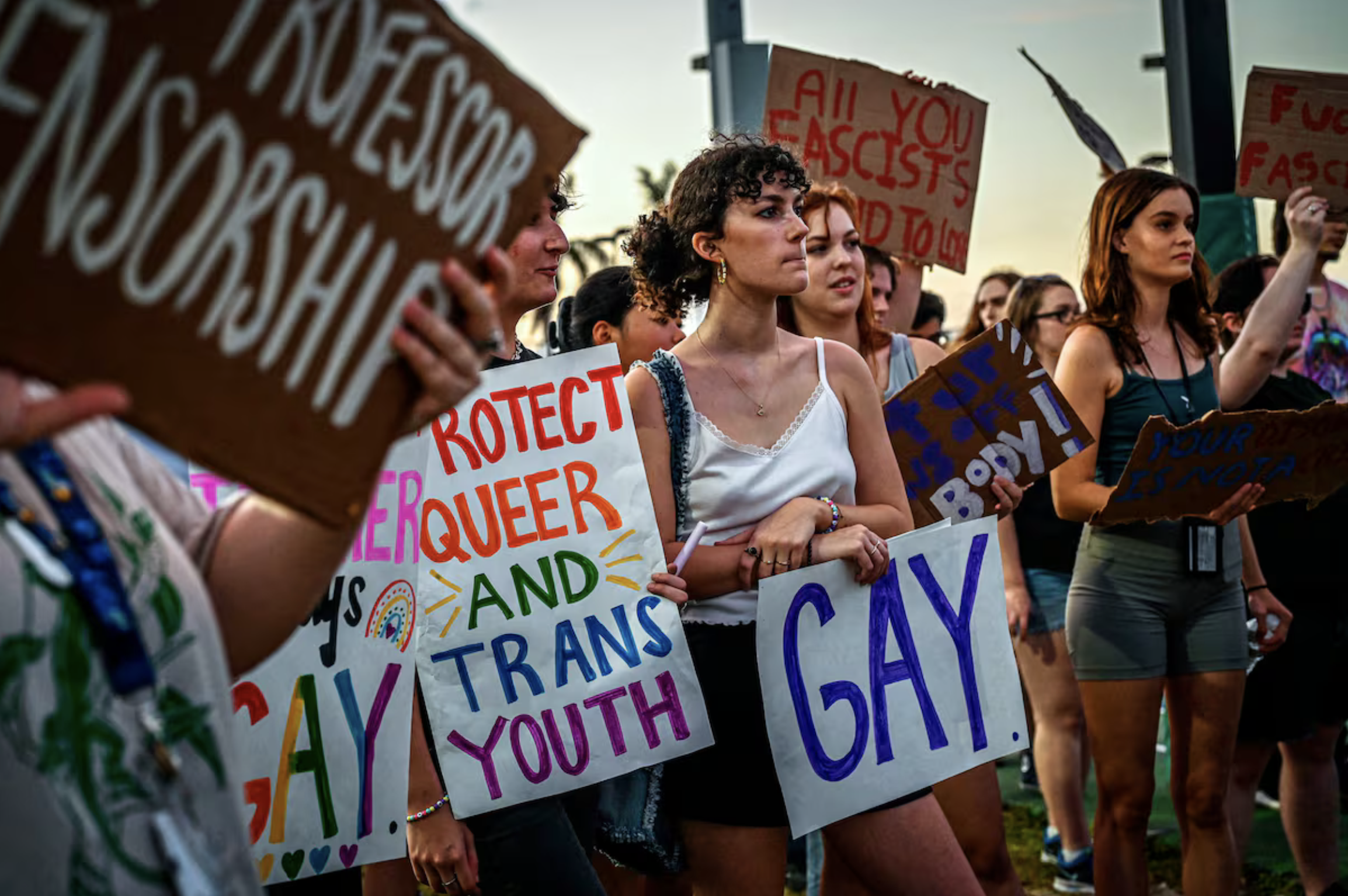
Fast-forward to the present. A recent Wall Street Journal profile of the “millennial socialist left” presents a trans activist as the symbolic face of contemporary socialism. A New York Times article reports on the “hot commie summer” in Portland, featuring DSA member Angelite Morilla in her office, with a trans flag in the window and a Mamdani sign posted outside. On the surface, this appears progressive and inclusive. But what is missing is revealing. Gone is any sustained focus on political economy and disputes over wages, ownership and control of capital assets, industrial decline, healthcare systems, corporate power, or the structure of economic advantage. Instead, socialism is framed primarily as a politics of identity: minoritarian, urban, academic, and culturally performative. Universal policies that would benefit ordinary working people and directly contest entrenched power are instead pegged to issues that concern only subsets of persons, as though those subsets were not already included among ordinary working people. The topic has been changed, and with it the social base, political aims, and strategic orientation of what now presents itself as “socialism.”
Granted, the majoritarian category “worker” includes anyone who works for a living, but only insofar as they work, not insofar as they belong to a particular subgroup. So what is achieved by insisting on emphasizing narrower and less universal categories?
The effect is clear. It undermines universal, majoritarian politics. Presenting socialist candidates as primarily concerned with highly specific cultural issues is divisive and unpopular, it functions as a distraction and diversion. It makes leftism or socialism appear to be something for an exotic minority rather than for the ordinary majority of people. Indeed, it often presents leftism or socialism as opposed to the ordinary majority (who frequently hold conventional views on such cultural questions) rather than opposed to their actual political and economic opponents. When socialism is presented in a form alien to the majority of wage earners, who would need to form its backbone, the result may appear radical but is structurally incapable of coordinated political action. Identity politics thus becomes not merely the perspective of the contemporary left, but the lens through which leftism itself is judged, rather than the material struggles that historically defined it. It becomes the point on which majoritarian politics repeatedly founders. And, ultimately, it means that what often seem like real political oppositions are just theater.

This brings us to a deeper structural shift. Historically, controlling opposition required deliberate action: agents provocateurs, covert funding, infiltration. Today, much of the left performs this function on its own. By emphasizing identity over class, fragmentation over coalition, and cultural symbolism over practical politics, the contemporary left often undermines its own capacity to appeal to a majority of workers. The structural outcome increasingly resembles what earlier regimes achieved through deliberate manipulation.
We might call this phenomenon “automatic controlled opposition” (ACO): an opposition that neutralizes itself without the need for external management or covert intervention. It may not be intentional, but functionally it produces the same outcome. The result closely resembles what earlier powers achieved through infiltration and manipulation: a visible but ineffective opposition, incapable of mounting serious challenges to those who control institutions, resources, and decision-making power. Whether external actors continue to encourage or amplify these tendencies, as they have historically, is plausible. The self-undermining dynamics are, however, already clearly visible on their own.
What makes the contemporary situation distinctive is that many of the techniques historically associated with deliberate sabotage now appear spontaneously within activist culture itself. The CIA’s Simple Sabotage Field Manual (1944), written as guidance for infiltrators and agents provocateurs, reads today less like an archival curiosity and more like an inadvertent description of contemporary organizational dysfunction: insistence on excessive proceduralism, refusal to permit expedient decisions, inflation of committees, obsessive disputes over wording, repeated reopening of settled questions, constant introduction of irrelevant issues, and the moralization of “caution” in ways that paralyze action. These were once recommended as techniques for undermining organizations from within. Today, they are widely treated as intrinsic norms of responsible organizing. Consider the preoccupation with “diversity” among professional-managerial leftists. Christian Parenti argues that “diversity” has functioned as a ruling-class ideology — a strategy to “divide and conquer” the class of people who have to work for wages for a living — and that this is nothing new. Yet now it is internalized by a perverted type of leftism, dominated by aspiring professional-managerial strata, threatened by downward mobility. And this clarifies the structural continuity between earlier elite strategies and present conditions. What once required deliberate orchestration increasingly reproduces itself automatically. The mechanism of neutralization has become second nature.
To understand the nature of this problem, consider the following scenario. Suppose a bill for universal healthcare were proposed that did not include coverage for abortion or other controversial medical procedures. It would benefit virtually everyone. Yet some, a minority, might oppose the proposal because it failed to include abortion access for certain individuals. This would constitute a case in which left-liberals de facto oppose a policy that would benefit the overwhelming majority of working people and deal a devastating blow to corporate interests that profit from the current healthcare system. In effect, it would defend the continued ability of those corporations to exploit the majority. This is not merely hypothetical: “Pro-Choice America opposed the 2016 single-payer referendum in Colorado because the state’s constitution banned public funding for abortions, and reproductive rights advocates feared the initiative would eliminate access to abortions for women now covered by private health plans.” Or consider Ta-Nahisi Coates now almost-forgotten criticism of Bernie Sanders and the latter’s universal policies because they weren’t good enough on specific issues for a minority of Americans. The result is that the majority cannot obtain normal medical care if some cannot obtain a controversial procedure. That is the ultimate effect. One might also observe that this pattern is not simply an inevitable feature of any left politics. It reflects decades of ideological formation that have reshaped priorities and instincts. In part, it’s the chickens coming home to roost from 75 years of anti-communist propaganda and controlled opposition.
This pattern is not merely the result of contingent bad decisions; it reflects a deeper transformation in the social composition of the left itself. There are other contributing factors as well. This development is rooted in the disappearance and replacement of the so-called Old Left, which was explicitly majoritarian and focused on political economy, by the so-called New Left, which focused on struggles against oppression of minorities and other identity-based groups. That disappearance and replacement, in turn, is rooted in the structural transformation of work over the course of the twentieth century. As waged industrial labor ceased to constitute the majority of work and as the economy shifted toward services and salaried or white-collar labor became increasingly prevalent, the social base of the left changed. In other words, the rise of the Professional-Managerial Class (PMC) explains both the decline of the Old Left and the standpoint of post-1960s leftism.
The middle-class orientation of the contemporary left explains why it is more concerned with etiquette, language, and barriers to promotion than with confronting concentrations of ownership and power. It explains why identity politics replaces the economic struggles that historically defined left politics. It also explains the contemporary left’s hostility toward the majority of ordinary working people. The professional-managerial class does not like ordinary, uncredentialed workers. Ultimately, one must recognize that there is no genuine continuity between the Old Left and the New Left, only a continuity of terminology. There is no serious sense in which the latter can be what the former was.
The implications are profound. Individuals may indeed face problems related to race, gender, and minority status. But when these concerns displace universalist politics as the organizing principle of socialism, the working majority becomes fragmented and disengaged. The left’s energy is redirected into struggles that, while culturally significant, do not seriously contest how power, wealth, and authority are organized. Many people appear to be seeing through this. And so, with “leftists” like these, as the saying goes, who needs controlled opposition? There is little here for entrenched elites to fear. These are precisely the kinds of opponents they would prefer to have. These “leftists” appear determined to lose, and to ensure that everyone aligned with them loses. If you attempt anything that might actually work, you are labeled a Nazi, as the example of EcoTechBro illustrates.

“Divide and conquer” is among the oldest strategies of empire. One would expect it from a minority of wealthy and powerful individuals defending their position against the interests of the many. Oligarchs love minorities because they are one, and because it is convenient to hide behind them while appearing virtuous through celebrations of “diversity.” Historically, one would not have expected this posture from the left, or at least from the old left. But this has changed. The left has become minoritarian, and it is now willing to lose every time, on behalf of the vast majority, if it cannot win by centering whatever minority figures it prefers. That is the problem.
History shows that power rarely leaves opposition to chance. From the Okhrana to Operation Trust to the CIA’s cultivation of an acceptable left, opposition has often been managed, neutralized, or co-opted. Today, a similar effect appears, often without deliberate orchestration. Much of the opposition now performs this work on its own. ACO, the self-undermining left, produces outcomes strikingly similar to classic controlled opposition. Whether through internal dynamics or ongoing elite amplification, the result is the same: a left that appears radical while remaining politically ineffective, incapable of building the broad, majoritarian coalitions required to contest the political power of the owner-class, the controllers it employs (PMC), and the institutional layers that protect it.
